Polymarket
Polymarket is an exchange where you trade shares in the outcome of real-world events. Is it legal in the US? Yes, Polymarket US is the CFTC-designated exchange, and probably every crypto expert has heard of it. You buy outcome shares priced between zero and one dollar, and each share settles at either one dollar or nothing.
- Launched2020
- Minimum age18+
On this page
At a glance
Identity
- Legal name
- Polymarket
- Launch year
- 2020
Regulatory status
- Status
- regulated
- CFTC registration
- Yes
- Minimum age
- 18+
Regulators: Commodity Futures Trading Commission
Markets and liquidity
- Contract type
- binary
- Liquidity / volume
- 1
Categories: Bet on Elections, Crypto Prediction Markets, Culture Prediction Markets, Economics Prediction Market, Sports Prediction Markets, Weather Prediction Markets
Fees and settlement
- Settlement source
- Exchange determines the outcome from the contract’s stated criteria and data sources.
Banking
USDC
Apple Pay
Google Pay
Revolut
Cryptocurrencies
What Is Polymarket?
So, how does Polymarket work? This is a prediction market, and it largely differs from a sportsbook or a casino.
Traders buy and sell shares tied to the outcome of a real-world event. What’s more, the share price reflects the market's live estimate of how likely that outcome is.
Who Founded and Owns Polymarket
Shayne Coplan is the name behind the brand. He founded the company and now leads it as Polymarket CEO. It's a private company, instead of a publicly traded one, so there's no stock ticker to look up.
An Exchange, Not a Sportsbook
Polymarket is an event contract exchange, not a sportsbook. Since its launch, it scaled fast. In the first half of 2025 alone, traders put roughly $6 billion into predictions on the platform.
Polymarket US and the International Platform
These are two separate platforms. The US exchange is QCX LLC, trading as Polymarket US, with QC Clearing LLC as its clearing house.
The international platform is a different venue. This one is run by Polymarket's offshore entity, and it blocks US IP addresses.
Is Polymarket Legal in the US?
The CFTC Position
Yes, US residents can trade legally through Polymarket US.
Polymarket bought QCEX on July 21, 2025. Then, a few months later, on November 25, the CFTC gave it an Amended Order of Designation, clearing Polymarket US to onboard customers through brokerages.
Using Polymarket in the US
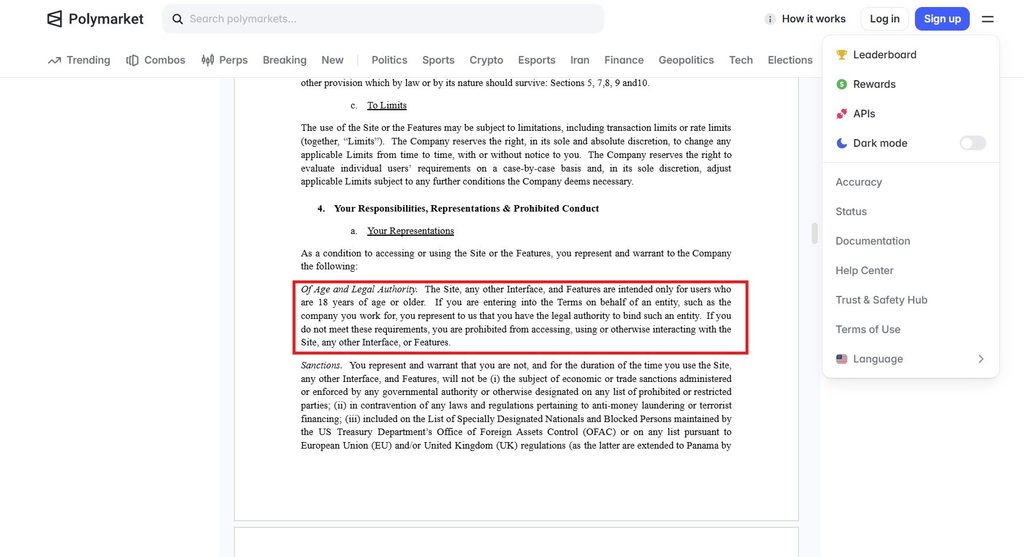
Can you use Polymarket in the US? The answer is yes; US residents trade on Polymarket US. But the international platform still blocks US IP addresses. Users must be 18 or older to use the platform.
On April 28, 2026, Polymarket filed with the CFTC seeking approval to let US users trade directly on the primary offshore exchange instead. Check the prediction markets tracker for the latest updates.
Is Polymarket Gambling?
No, not in the regulatory sense. Event contracts here are federally regulated derivatives, overseen by the CFTC.
So this is not a state-licensed gambling product.
State-Level Questions
We know that prediction markets are federally regulated.
Because of this, there's no separate Polymarket page for California, Texas, or any other state. Availability is national through Polymarket US, and the federal answer above covers every state at once.
What You Can Trade on Polymarket
The Market Categories
Polymarket covers all of these:
- politics and elections,
- geopolitics,
- economics,
- crypto,
- sports,
- culture and entertainment, and
- science and technology.
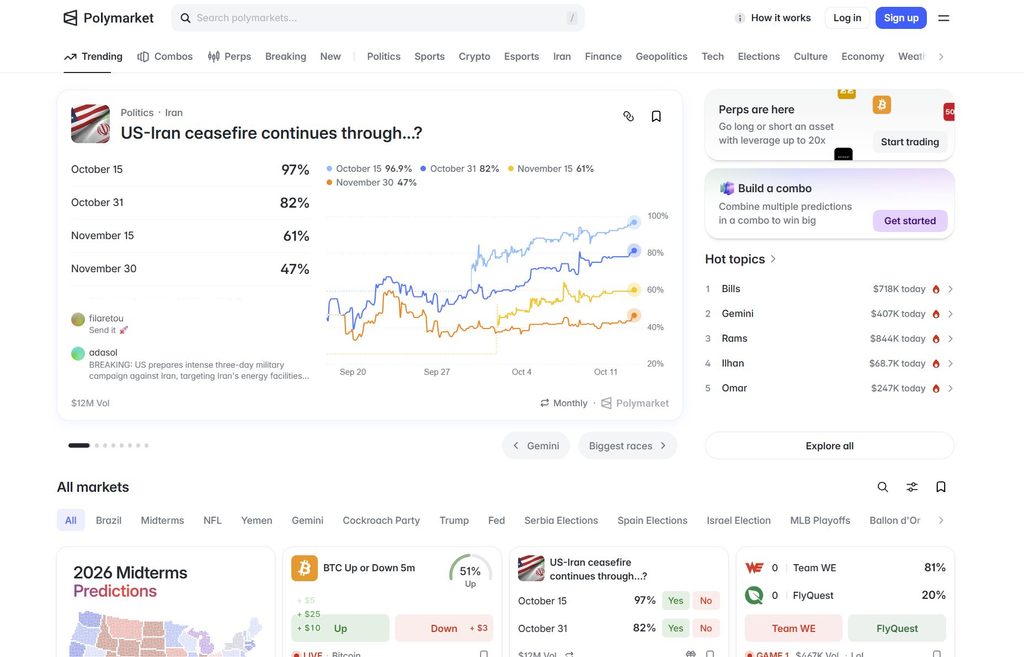
How Outcome Shares Work
You buy Yes or No shares priced between zero and one dollar. That price is the market's implied probability of the outcome happening.
Notably, each share settles at one dollar if you're right, or nothing if you're wrong. Positions are fully collateralized. So there’s no margin or leverage, and you can sell before the event resolves if you want out early.
Can You Parlay on Polymarket?
Not in the sportsbook sense. Trades here match on a central limit order book, meaning price is set by real-time supply and demand between traders.
That's different from a sportsbook, where an algorithm sets the parlay odds for you.
Volume and the Leaderboard
At the time of writing, Polymarket processed $3.8 billion in trading volume over the trailing 30 days. This is per DefiLlama's live dashboard.
Zoomed out further, Polymarket, Polymarket US, and Kalshi together cleared $44.8 billion in June 2026, up 75% from May's $25.7 billion, largely driven by World Cup markets.
Across the whole category, Q2 2026 global prediction-market volume hit roughly $111 billion, up from $80 billion in Q1.
Polymarket Fees and How Markets Settle
Trading Fees on Polymarket US
This isn't a flat percentage, as it's sometimes described. Per Polymarket US's own fee schedule (effective July 1, 2026), the taker fee is a formula that peaks on close-to-50/50 markets and shrinks toward the extremes.
On a $1,000 trade at even odds, that works out to a few dollars. Overall, no flat rate applies uniformly. Limit orders are resting on the book rather than filling instantly. Also, they earn a rebate under the same formula.
Fees on the International Platform
The international platform runs a different, category-based schedule.
Namely, taker fees range from 0% on geopolitics markets up to roughly 1.80% on crypto markets. And maker orders are free across the board.
How Polymarket Makes Money
You may be asking yourself - how does Polymarket make money? Neither platform charges a deposit or withdrawal fee. USDC withdrawals on Polygon cost under a penny in network gas.
Notably, the trading fees above are where the business truly makes its money.
How a Market Settles
Note that settlement works differently by platform. International contracts use the UMA optimistic oracle.
A proposer posts a bond backing an outcome. So, anyone who disagrees can challenge it with a token-holder vote.
Polymarket US contracts resolve under the exchange's own rulebook instead. Each contract names its settlement source, which is self-certified to the CFTC.
Position Limits
This prediction market giant doesn't publish an account-wide cap.
Since every contract is fully collateralized, your exposure is naturally bounded by how much you've deposited.
What’s more, per-contract limits are set in the rulebook. That contrasts with PredictIt, which caps at $3,500 per contract.
Funding a Polymarket Account
Funding Polymarket US
You can fund Polymarket US in actual US dollars by debit card, ACH transfer, or wire transfer.
Apple Pay is also supported here.
Funding the International Platform
The international platform works differently. It funds in USDC on Polygon, plus cross-chain deposits.
Yet, most people just buy USDC with a card, right in the deposit flow. Fees run 2% to 4%, and money lands in a couple of minutes.
Already have USDC? You can send it in on Polygon, or link Coinbase for cheaper, faster transfers.
The Polymarket App
iOS and Android
Polymarket ships a native app on both iOS and Android. You can also just use the web platform if your prefer that route.
Frequently asked questions
Is Polymarket legal in the US?
Yes, through Polymarket US. QCX LLC, trading as Polymarket US, is a CFTC-designated contract market, and QC Clearing LLC is its registered clearing house. The international platform still blocks US IP addresses. Availability is national rather than state by state, so California and Texas are answered at the federal level.
Is Polymarket legit?
Yes, Polymarket is a federally designated exchange market by the CFTC. It settled a CFTC enforcement action in 2022 with a $1.4 million fine and a cease-and-desist, then acquired QCEX in July 2025 for $112 million, gaining a designated contract market designation and a clearing registration. Both entities are verifiable on the CFTC's public register.
What is Polymarket and how does it work?
Polymarket is an exchange where you trade shares in the outcome of real-world events. A Yes or No share trades between zero and one dollar, so the price is the market's implied probability, and it settles at one dollar or nothing. Trades match on an order book, and you can sell before resolution.
What fees does Polymarket charge?
It depends which platform you use. Polymarket US charges a 0.30% taker fee with a 0.20% maker rebate as at July 2026. The international platform charges category-based taker fees from 0% on geopolitics up to 1.80% on crypto, with maker orders free. Neither charges a deposit or withdrawal fee.
Who owns Polymarket?
Polymarket was founded by Shayne Coplan, who remains chief executive. It is a private company rather than a listed one, which is why there is no Polymarket stock to look up. Its US exchange, QCX LLC, and clearing house, QC Clearing LLC, were bought as QCEX for $112 million in July 2025.
Reader reviews
Write a reviewYou need an account to submit a reader review.
PolymarketVerdict 89/100. 18+, terms apply.
Visit Polymarket Polymarket (opens in a new tab)